Three layers
What do the fees actually come to?
There are three separate layers of cost, and the largest is frequently the one that carries no fee label at all. This explains where each is charged and gives you a comparison method that cannot be dressed up.
Step: Payment methods and fees
Three layers: getting money in, the trade itself, and getting coins out. The first two are proportional. The third is fixed.
And there is a fourth cost that never appears as a fee line at all — the spread. On a one-click purchase it is usually the largest single cost you pay.
Three layers#
| Layer | Roughly | Proportional or fixed |
|---|---|---|
| Getting money in | Free to a few percent | Depends — transfers are often free, cards are proportional |
| The trade | A fraction of a percent on spot; commonly 1–2% via one-click | Proportional |
| Getting coins out | A flat amount per withdrawal | Fixed — this is the one that hurts small amounts |
Layer 1: getting money in#
This varies more by country than by platform.
- Local instant bank transfer is commonly free or close to it. Where it is available it is nearly always the cheapest entry.
- Debit card carries a card-channel fee, typically a percentage.
- Credit card carries the same, plus whatever your issuer adds — and many treat it as a cash advance, which means interest from day one and a separate advance fee. That issuer charge is frequently larger than everything the platform charged you.
- Peer-to-peer usually has a zero platform fee, with the cost sitting in the seller’s rate instead.
Layer 2: the trade itself#
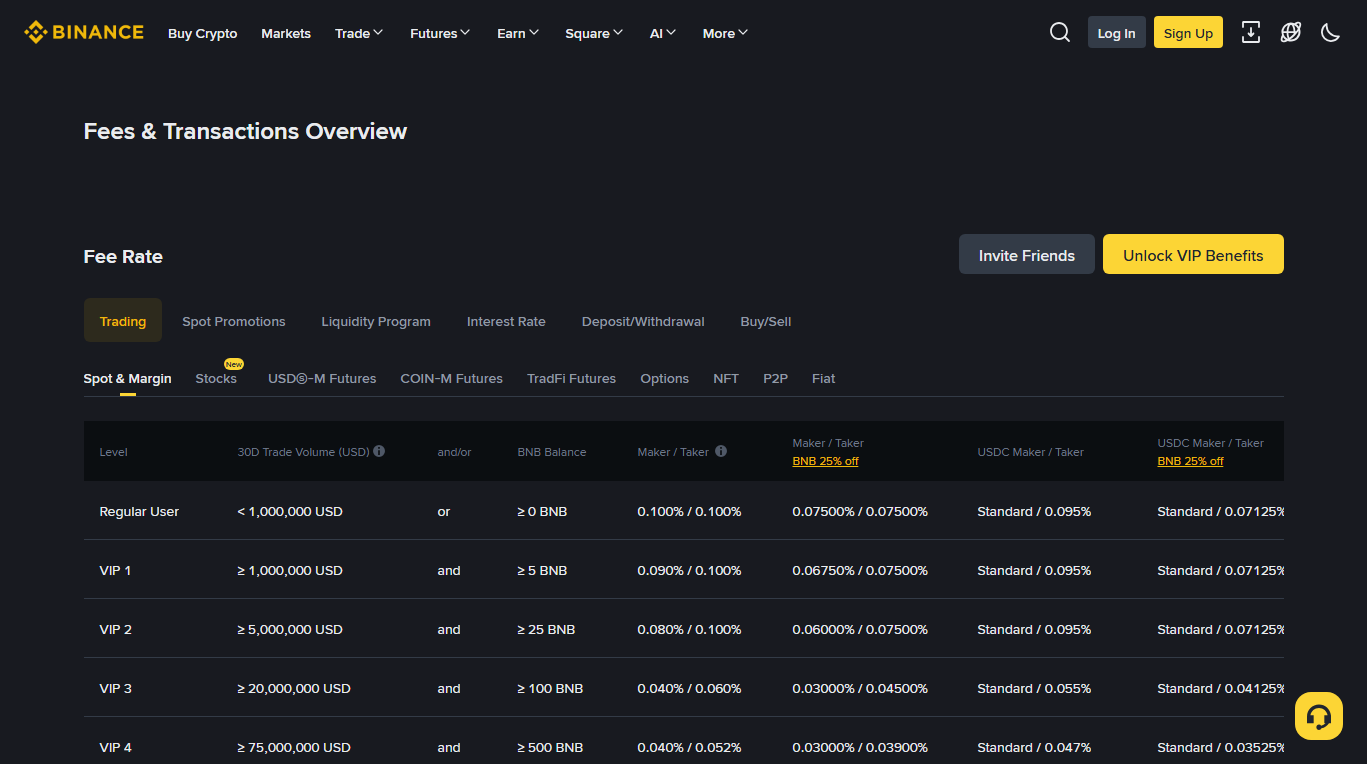
On the spot market this is the layer that actually carries a published fee, and it is usually small — a fraction of a percent. Two details worth knowing:
-
Maker and taker are priced differently
An order that fills immediately against existing orders is a taker order. One that sits on the book waiting is a maker order. Maker fees are typically lower, sometimes zero. A market order is always a taker order.
-
The fee is usually taken in the asset you bought
Which is why your balance can read slightly less than the round number you expected. See below.
Layer 3: getting coins out#
Withdrawing to your own wallet costs a fixed network fee, set by network conditions rather than by the amount you are moving. Moving twenty dollars and twenty thousand dollars costs the same.
This is the single most important fee fact for a beginner, because it is the only one where buying small is genuinely penalised. The arithmetic is laid out in the worked example.
It is not “do not buy small”. It is do not withdraw small amounts repeatedly. Each withdrawal pays the fixed fee again. Accumulating and withdrawing once costs a fraction of withdrawing five times.
The layer with no name#
This is where most beginners actually lose the most, and it never appears as a fee.
A one-click or express buy quotes you a single price. That price is typically some way above what the same coin costs on the spot market at the same moment. That difference is your cost. It is real money, it is usually larger than the trading fee, and the page can say “0% fee” while it is being charged — because technically no fee line was added.
The same applies to peer-to-peer: the platform fee is often genuinely zero, and the seller’s rate carries the premium instead.
Both statements can be literally true at once. Whenever you see a zero-fee claim, the question to ask is not “what is the fee” but “what rate am I being given, compared to the market rate right now”.
Why the balance reads 0.999 instead of 1#
This alarms a lot of people and it is not an error.
When the trading fee is charged in the purchased asset, you pay for a quantity and receive that quantity minus the fee. Buy what should be 1 unit at a 0.1% fee and you hold 0.999. Nothing went missing and nobody made a mistake — the fee simply came out of the coin rather than out of cash.
Some platforms let you pay fees in a separate token instead, often at a discount, in which case the purchased quantity stays round.
The only comparison nobody can game#
Comparing advertised rates across platforms is close to useless, because they are not all charging in the same place. There is one comparison that works everywhere:
How much money left my account in total?
How much of the coin do I hold as a result?
Divide the first by the second and you have your true all-in cost per unit. Compare that against the market price at the moment you bought. That gap is everything you paid, across all layers, however it was labelled.
This works because it is measured at the two ends and ignores the middle entirely. Spread, fee, markup, premium — whatever it was called, it shows up here.
Common questions#
What is the cheapest overall route?
Generally a free local bank transfer, a spot limit order, and not withdrawing immediately. The most expensive is usually a credit card into a one-click buy followed by a small withdrawal — that combination stacks every costly layer at once.
Do I pay a fee again when I sell?
Yes. The trading fee applies on both sides. This is one reason buying and quickly selling is more expensive than people expect.
Is one-click buy a rip-off then?
Not exactly — it is expensive, and for a first purchase that can still be a reasonable trade. What you buy with the extra 1–2% is fewer steps and fewer places to make a mistake. Once you have done it once, spot is straightforward and noticeably cheaper.
Why is the withdrawal fee different on different networks?
Because it reflects the cost of that particular network, which varies with congestion. The network you choose must match what the receiving side requires — picking a cheaper one that the recipient does not support means the coins are unrecoverable.
Are fees negotiable or reducible?
Trading fees typically fall with volume, and some platforms discount them if you pay in their own token. Neither is worth optimising for on a first purchase.
Last updated: 25 August 2026. All percentages here are illustrative orders of magnitude to show how the layers behave, not quotes — real rates change constantly and vary by market. Go by what your screen shows before you confirm. Not investment advice.
Related
- What is the minimum I can spend? The worked example on fixed costs
- Getting money in Which funding route costs least
- I cannot find my coins Including why the number looks wrong