Funding
Getting money in: which methods actually work
Whether you can fund an account is decided mostly by your country and your bank, not by the exchange. This is why “it worked for me” from a stranger online tells you very little about your own situation.
Step: Payment methods and fees
Whether you can get money in is mostly not about the exchange — it is about where you are and which bank you use. The same platform, the same interface, shows a completely different list of payment options depending on your jurisdiction.
Which is why somebody saying “I just used a card, it was fine” may be entirely true and entirely useless to you.
Three routes, first#
Every funding method ends up being one of three things. Working out which one you are on clears up most of the confusion.
| Route | Where your money goes | Cost | Suits |
|---|---|---|---|
| A. Buy from the platform “One-click buy” / “Express buy” | To the platform’s fiat channel; the platform hands you the coin | Medium to high — markup is inside the quote | A first purchase, small amount, fewest places to go wrong |
| B. Peer-to-peer Trading with another user | Straight to another user’s bank account; the platform holds their coin in escrow | Low — platform fee is often zero | Where local payment methods are plentiful and route A is closed |
| C. Transfer in crypto you already hold | No fiat involved — it comes from another wallet or platform | Only the network transfer fee | People who already hold something |
If you are starting from nothing, route C does not apply and your real choice is between A and B.
Each method in turn#
Bank transfer
Usually the cheapest route where it is available. Most countries now have some form of instant domestic transfer — SEPA Instant across the euro area, Faster Payments in the UK, ACH and wire in the US, PayNow in Singapore, FPS in Hong Kong, DuitNow in Malaysia, UPI in India, PIX in Brazil, Osko/PayID in Australia.
- Cost: commonly free or a very small flat fee.
- Speed: minutes on an instant rail; hours to a working day on older systems; one to three working days for an international wire.
- Watch for: some banks apply internal policy to crypto-related payments and will decline outright or ask what the payment is for.
Debit card
Works widely, costs more than a transfer. The convenience is real — it is near-instant and requires no separate step. What you pay for it is a card-channel fee on top of whatever markup sits in the quote.
Card payments also fail more often than transfers, usually at the 3-D Secure step or because the issuer declines the merchant category outright.
Credit card
Possible, and generally a bad idea. Three reasons, increasingly practical:
-
The platform-side fee is higher than for a debit card
Card channels cost the platform more and that is passed on.
-
Many issuers treat it as a cash advance
That means no interest-free period — interest accrues from the day it posts — plus a separate cash-advance fee. This charge is frequently larger than everything the exchange charged you.
-
The coins are often withdrawal-locked for a period
Because card payments can be charged back, platforms hold the purchased asset until the chargeback window closes.
The underlying objection is simpler than any of those: buying a volatile asset on a credit card is borrowing money to speculate.
Peer-to-peer
You trade directly with another user: the platform holds their crypto in escrow, you send fiat to their bank account and mark the order as paid, and once the seller confirms the money has arrived in their account, the crypto is released to you. If the seller does not release, you can open an appeal on the order and the platform steps in. The platform is the guarantor throughout.
When choosing a counterparty, look at three numbers: completed order count (higher is steadier), completion rate (below 95%, skip them) and average release time. A fraction of a percent better on price matters far less than not having a problem.
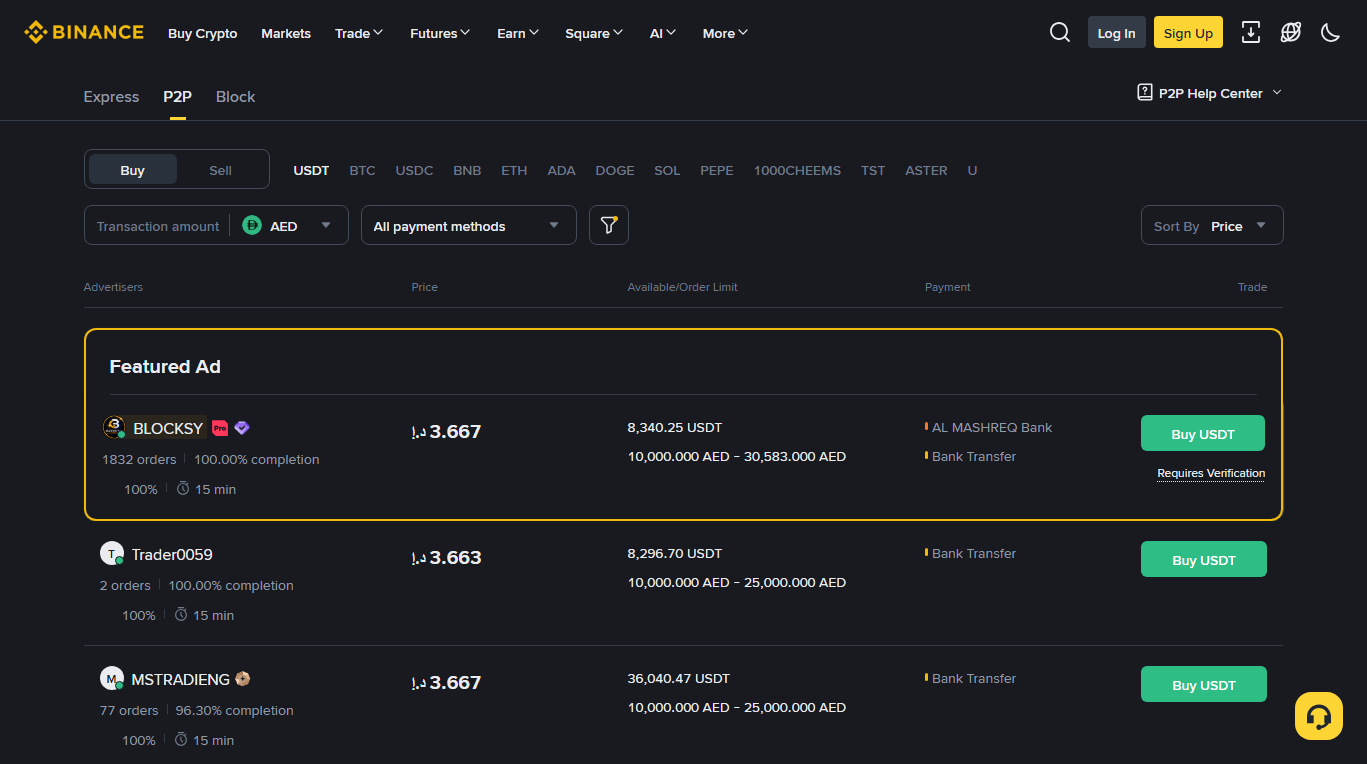
1. Stay inside the platform the whole time. Anyone asking you to move to Telegram, WhatsApp or email and settle privately — cancel the order and report them. Outside the platform there is no escrow, and money you send is simply gone.
2. Put nothing in the payment reference except what the platform asks for. Not the coin name, not the platform name. If the order page gives you a specific reference to include, use exactly that and nothing more. This is not about concealment — many banks screen references for keywords and will stop the transfer.
3. Money counts as paid only when it has really moved. As the buyer, mark the order as paid only after your transfer has actually gone out from your bank. If you are ever on the selling side, release only when your own banking app shows the money as received — “I’ve already paid, please release”, screenshots and SMS confirmations are trivially faked.
4. Pay from an account in your own name. Using a family member’s account gets flagged as payer/holder mismatch, the order can be cancelled, and getting the money back needs an appeal.
Third-party wallets (Apple Pay, Google Pay and similar)
Supported in some regions. Underneath it is still the card you linked, so the cost and the limits follow that card. The upside is not re-typing a card number; the downside is that it is very easy to pay before you have finished thinking.
Roughly what works where#
General patterns only. Platform coverage and regional policy change constantly — treat what your own screen offers you as the authority, not this table.
| Where you are | Usually works | Usually does not |
|---|---|---|
| United States | A US-facing regulated platform, typically with ACH and debit card | International main sites will route you elsewhere — see the region prompt in the registration guide |
| United Kingdom | Faster Payments, debit card — on a UK-registered platform | Binance has not accepted new UK users since October 2023; several UK banks also restrict crypto payments as internal policy, and credit cards are widely blocked |
| Euro area | SEPA and SEPA Instant, local debit cards | — |
| Canada | A Canadian-registered platform | Binance announced its withdrawal from Canada in May 2023 |
| Australia | Osko/PayID, bank transfer, debit card | Several banks apply limits to crypto payments |
| Singapore | An MAS-licensed local platform | Binance.com switched off fiat deposits, fiat purchases and spot trading for Singapore users on 26 October 2021 (official notice); Binance.sg has closed. PayNow does not help you on Binance.com |
| Hong Kong | FPS local transfer, some cards, licensed platforms | Some banks restrict crypto payments internally |
| Japan / South Korea | Domestic regulated exchanges with local bank transfer | International platforms are often restricted for residents |
| India | UPI and bank transfer, peer-to-peer widely used | Bank willingness varies considerably and changes |
| Mainland China | No compliant route exists | Domestic bank cards and payment apps — regulation explicitly prohibits these services |
Region status checked on 6 October 2026 against: Binance’s own notice Access to Alternative Platform for Users in Singapore (restrictions from 26 Oct 2021; Binance.sg has since closed); the May 2023 Canada exit; and the October 2023 halt on new UK sign-ups. Platforms change their coverage — the notice you see on the site the day you open it wins.
How long it takes#
| Method | Normally | What slows it down |
|---|---|---|
| One-click buy (card) | Seconds to minutes | A failed 3-D Secure check means starting again |
| Instant domestic transfer | Minutes | Some banks delay the first payment to a new payee |
| Standard bank transfer | Hours to one working day | Weekends and public holidays are not processed |
| International wire | 1–3 working days | Intermediary banks, or one wrong detail |
| Peer-to-peer | Usually released within 15 minutes of payment | The seller is asleep — you can open an appeal on timeout |
When your payment is declined#
First work out who declined you. The two cases are handled completely differently.
The platform declined it
You get an on-screen message, typically “this payment method is not supported in your region”, “exceeds limit” or “verification level insufficient”. Follow the message: switch method, raise your verification tier, or accept that this route is closed.
Your bank declined it
This shows up as a failed charge, a returned transfer, or a risk warning message from the bank. Likely causes:
- the bank applies internal restrictions to crypto merchants — you cannot change this, only change bank or method;
- it was scored as unusual — first-time, larger amount, foreign merchant; any two of those is often enough;
- a keyword in the payment reference triggered screening;
- the card is not enabled for international or online transactions.
What you can actually do: call the bank and ask why (they will usually tell you), retry with a smaller amount, try a card from a different bank, or switch to peer-to-peer.
If you have tried several routes and all of them fail, the honest conclusion is usually that this cannot be done from your current country and banking situation.
At that point somebody online will offer you “another way” — buying on your behalf, using someone else’s account, an “internal channel”. What all of these have in common is that you hand money to a person you do not know, with no recourse whatsoever. The cost you save is not remotely worth the probability of losing everything.
Common questions#
What is the cheapest way to fund an account?
Generally a local bank transfer, then placing your own order on the spot market. Peer-to-peer often has a zero platform fee, but the seller sets the rate, so your real cost is in the premium. One-click buy is the easiest and the most expensive.
How much should I move in first?
Send a small amount and run the whole path once — confirm the money arrives and a purchase completes — before committing a real amount. Sending a large sum first to save one transfer fee is a very common source of regret.
I sent the wrong amount. What happens?
An overpayment by bank transfer normally either bounces back or sits in your platform balance — it does not vanish. On peer-to-peer you need the counterparty to refund, and platform support can step in. A completed purchase, however, cannot be undone.
Why am I being asked for proof of source of funds?
Larger deposits trigger anti-money-laundering review, and you may be asked for a payslip or bank statement. Provide it accurately — this is routine at any regulated financial institution.
Peer-to-peer gave me USDT, not bitcoin. Did I do it wrong?
No, that is normal. Peer-to-peer markets mostly trade stablecoins. You then use that on the spot market to buy BTC. It is one extra step, and the two steps combined are usually still cheaper than one-click buy.
Money is in — next is placing the order
The three numbers to check before you press confirm, and how to choose between order types, are in the ordering stage of the main walkthrough.
Last updated: 7 October 2026. Regional regulation, platform coverage and internal bank policy all change without notice. What is described here is the general picture as of August 2026 — go by what your screen shows and what applies where you live. This is not investment or legal advice.
Related
- The full walkthrough Where funding sits in the whole process
- What beginners get wrong most often Read before it happens, not after
- Opening an account Every field, and how to fix each rejection