Honest answer
Do I have to verify my identity?
The short answer is yes, and it cannot be skipped on a regulated platform. Rather than just asserting that, this explains where the requirement comes from, what you hand over, and what the alternatives genuinely cost.
Yes. Every regulated exchange requires identity verification — commonly called KYC, for “know your customer” — before you can fund an account or trade meaningfully.
It is a legal obligation the platform operates under, not a preference they could waive if you asked nicely.
Why it exists#
It is worth understanding rather than just resenting, because it explains why no amount of shopping around finds a regulated platform that skips it.
Anti-money-laundering law in essentially every major jurisdiction requires financial institutions to know who their customers are. As crypto exchanges came under financial regulation, that same obligation was extended to them. A platform that ignored it would lose its licences and its banking relationships — which is a far larger problem for them than losing you as a customer.
This is the same requirement that applies when you open a bank account or a brokerage account. It is not specific to crypto and it is not a judgement about you.
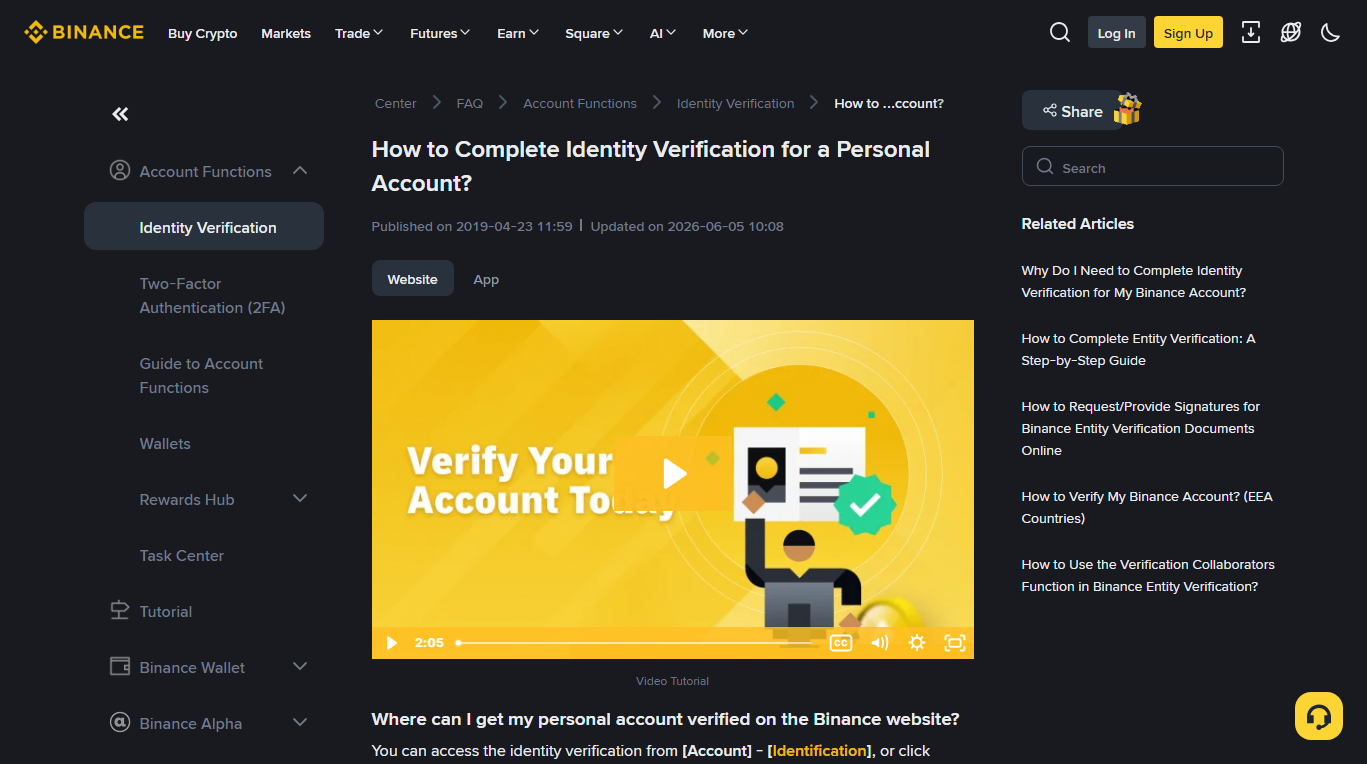
What they actually ask for#
| Step | What is collected | Notes |
|---|---|---|
| Personal details | Full name, date of birth, address, sometimes nationality | These must match the document exactly — including middle names and name order |
| Document images | Passport, national ID or driving licence, usually front and back | Which types are accepted depends on your country |
| Liveness check | A short selfie video — turn your head, or blink | Confirms a real person is present rather than a photograph |
| Proof of address | A utility bill or bank statement | Only at higher tiers, or for larger amounts — not usually needed to start |
| Source of funds | Payslip, bank statement | Triggered by larger deposits. Routine at any regulated institution |
Review is often automatic and completes in minutes. When it goes to manual review it can take a day or two, which is normal and not a sign of a problem.
If it is rejected, the fix depends on the exact wording of the error — the full table is in the registration guide. The overwhelming majority of rejections are photograph quality, not anything about you.
What happens to the documents#
An honest answer here has two halves.
The reassuring half: a regulated exchange holds this data under the same kind of obligations a bank does, including retention rules and data protection law. Verification is frequently handled by a specialist provider rather than built in-house.
The half nobody should skip: handing identity documents to any institution is a real transfer of risk. Data breaches happen, including at large and well-resourced companies. This is a genuine cost of participating, and anybody telling you it is nothing is not being straight with you.
What you can reasonably do about it: use a platform large enough to be genuinely regulated rather than one that merely claims to be, keep your own account secure so a breach elsewhere does not compound, and — most importantly — make absolutely sure you are on the real site before uploading anything.
The routes around it#
They exist. Rather than pretend otherwise, here is what each actually costs.
| Route | What you give up |
|---|---|
| Decentralised exchanges | No account, no support, no recourse. You interact directly from a wallet you control — and a mistake is permanent, with nobody to appeal to. Also generally requires you to already hold crypto, so it does not solve the first purchase |
| Peer-to-peer outside a platform | No escrow. You are sending money to a stranger on trust. This is the single most reliable way for a beginner to lose everything |
| Bitcoin ATMs | Often much worse rates, frequently 5–15% above market, and many now require identification anyway |
| Buying or borrowing an identity | The account is legally not yours. This surfaces exactly when you try to withdraw a meaningful amount, and at that point you have no standing to recover anything |
Services offering to “get you verified” using someone else’s documents are selling you an account you cannot safely use. When a withdrawal triggers review — and eventually one will — the name on the account is not yours, and there is no version of that conversation that ends well.
For a first purchase, every one of these trades away precisely the protections a beginner most needs. That is why this site recommends going through verification rather than around it.
The real risk is somewhere else#
People worry about handing documents to a legitimate exchange. Meanwhile the far more common and far more damaging failure is handing documents to a fake one.
A phishing site that convincingly mimics the real platform will happily collect your ID photos, your selfie, your email and your password — and that combination is worth considerably more to an attacker than any single one of them.
This is why checking you are on the real site matters more than every other step, and why it is worth thirty seconds of reading the address bar rather than clicking a link somebody sent you.
Common questions#
Can I browse prices without verifying?
Usually yes — market pages are typically public and need no account at all. Verification is required to fund and trade.
I verified but still have limits. Why?
Verification tier is only one of several separate limits. New-account cooling periods, payment-method caps and regional restrictions all exist independently. Explained in the registration guide.
Does verification mean my holdings are reported to tax authorities?
Reporting obligations vary by country and change over time, and we are not in a position to tell you what applies where you live. Assume that a regulated platform operates under the reporting rules of its jurisdiction, and check your own local requirements. This is not tax advice.
Can I use a different name because I value my privacy?
No. The name must match the document, and a mismatch fails verification. Attempting it usually results in the account being frozen for review.
What if I do not have any accepted document?
Then that platform is not available to you. Accepted document types differ between platforms and regions, so another may accept what you have — but there is no regulated route with no document at all.
Last updated: 25 August 2026. Regulatory requirements differ by country and change over time. What is described here is the general pattern as of August 2026 — confirm what applies where you live. This is not legal or tax advice.
Related
- Opening an account, field by field Including how to fix each rejection
- The verification code never arrives The other common stall
- Privacy What this site does and does not collect