Misconception
Can I buy just 0.001 bitcoin?
Short answer: yes, and you can go far smaller than that. If you have assumed you need to buy a whole coin, that assumption can stop you before you start, so it is worth explaining properly rather than just asserting it.
Step: Before you start
Yes. 0.001 BTC is a perfectly ordinary purchase, and you can buy much less than that. Bitcoin divides to eight decimal places, so the smallest possible unit is 0.00000001 BTC.
Most people who own bitcoin own a fraction of one. Owning less than a whole coin is the normal case, not the exception.
Why so many people think otherwise#
It is not a silly misunderstanding. Three things line up to produce it:
-
Every headline quotes the price of one
“Bitcoin passes $X” is always the price of a single coin. That is the only number most people ever see, so it becomes the mental price of entry.
-
We buy things in units of one
You buy a phone, a ticket, a coffee. Nothing in ordinary life is priced in hundred-millionths. There is no everyday intuition for a currency that subdivides that far.
-
Nobody says it out loud
People already in the space find it too obvious to mention, so beginner-facing coverage tends to skip straight past it.
The result is a large number of people who concluded, reasonably, that this was something for people with far more money than them — and stopped there.
What a satoshi is#
One bitcoin divides into 100,000,000 units. The smallest unit is called a satoshi, usually shortened to sat.
| You see | Same thing written as | Fraction of one coin |
|---|---|---|
| 1 BTC | 100,000,000 sats | One whole coin |
| 0.01 BTC | 1,000,000 sats | One hundredth |
| 0.001 BTC | 100,000 sats | One thousandth |
| 0.0001 BTC | 10,000 sats | One ten-thousandth |
| 0.00000001 BTC | 1 sat | The smallest possible |
Some interfaces display small holdings in sats rather than in decimals, because 18,432 sats is easier to read than 0.00018432 BTC. If you see that notation, it is the same thing written differently.
What you actually type into the order box#
This is the part that resolves the confusion completely.
On almost every buy screen, you type an amount of money, not a quantity of coin. You enter what you want to spend and the platform calculates how much BTC that comes to at the current price. You never do the division yourself.
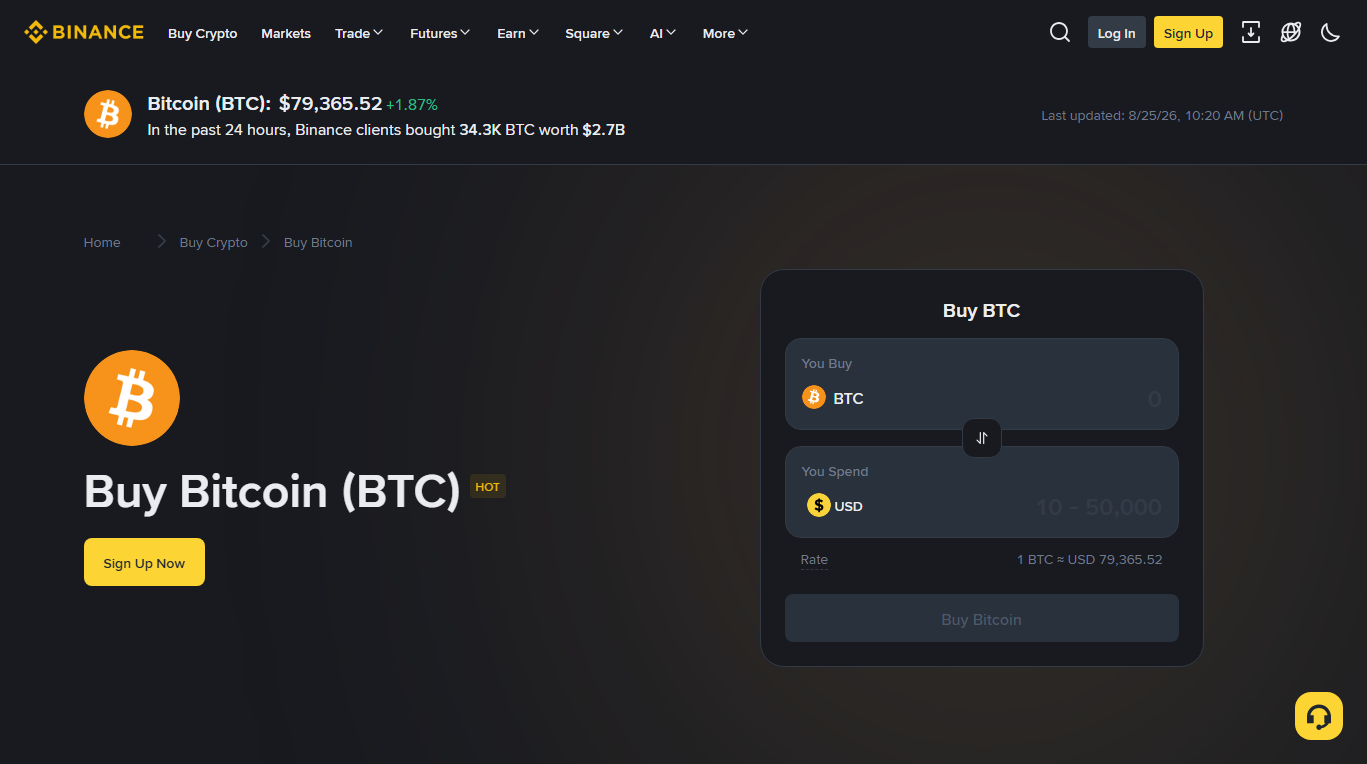
So the question “can I afford 0.001” is not really the question you will face. The question the screen asks you is “how much do you want to spend”.
Some screens let you switch the input between money and quantity. If you switch to entering a quantity, read it twice — the difference between 0.01 and 0.001 is a factor of ten, and a filled order cannot be undone.
Is buying a small amount pointless?#
This is the reasonable follow-up question, and it deserves a real answer rather than encouragement.
It depends entirely on one thing: whether you intend to withdraw it.
- Buying small and leaving it on the platform: your costs are proportional — the funding fee and the trading fee take the same percentage regardless of size. A small purchase is not penalised. “Too small to be worth it” is simply not true here.
- Buying small and withdrawing immediately: the network withdrawal fee is a fixed amount. On a small purchase that fixed cost can be an enormous proportion of what you put in.
So the sensible rule is not “do not buy small”. It is do not withdraw small amounts frequently. The arithmetic is worked through in what the fees actually come to.
Common questions#
Is there a minimum order size?
Platforms set one, typically around ten dollars equivalent, and it varies by market and payment method. That is a platform rule, not a property of bitcoin. See what is the minimum I can spend.
Do I own “real” bitcoin if I only own a fraction?
Yes. A fraction is not a different or lesser asset — it is the same thing in a smaller quantity, exactly as owning some grams of gold rather than a bar.
Why does my balance read 0.000999 instead of 0.001?
The fee was taken in the coin rather than in cash, so you hold slightly less than you paid for. This is normal and not an error. Explained in the fees article.
Can I buy a fraction of other cryptocurrencies too?
Generally yes, though the number of decimal places differs by asset. The principle is the same.
Last updated: 25 August 2026. This page explains how the units work and is not investment advice. Nothing here is a suggestion about whether or how much to buy.
Related
- What is the minimum I can spend? Where “possible” and “sensible” diverge
- What do the fees actually come to? Why fixed costs hurt small amounts
- The full walkthrough The whole process, start to finish